

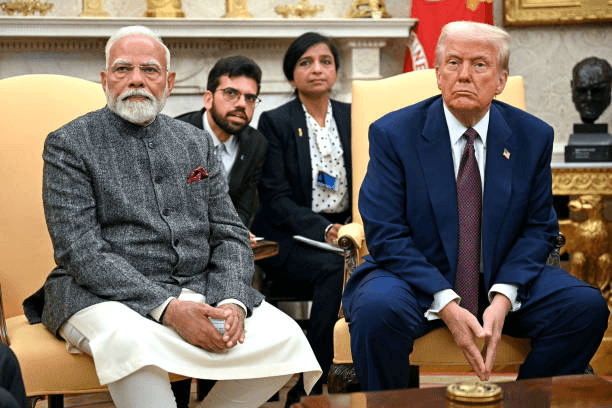
WASHINGTON D.C. — President Donald Trump has acknowledged a growing strain in trade relations with New Delhi, stating that Indian Prime Minister Narendra Modi is “not very happy” with the United States following the imposition of significant import duties.
Speaking at the House GOP Member Retreat on Tuesday, President Trump highlighted the complexity of the bilateral relationship, balancing personal rapport with aggressive economic policy. The President specifically cited the 50% tariff currently levied on Indian goods—a figure that includes a 25% penalty specifically tied to India’s ongoing procurement of Russian crude oil.+1
Defense Procurement and Manufacturing Delays
During his address, the President used India’s recent military acquisitions as a primary example of his administration’s push to overhaul American defense manufacturing timelines. According to Trump, Prime Minister Modi personally intervened to address a five-year delay in the delivery of 68 Apache attack helicopters.
“Prime Minister Modi came to see me—sir, may I see you, please? Yes,” Trump recounted, mimicking the interaction. “I have a very good relationship with him. He’s not that happy with me because, you know, they’re paying a lot of tariffs now.”
The President emphasized that his administration is “changing” the way foreign military sales are handled to ensure allies receive hardware without the multi-year backlogs seen in previous terms.
The Russian Oil Factor
The core of the current trade dispute centers on India’s energy imports from Moscow. While Trump noted that India has “very substantially” reduced its Russian oil intake, he maintained that the tariff pressure was necessary to discourage trade that indirectly supports the Russian economy during the ongoing Ukraine conflict.+1
Despite the economic friction, Trump reiterated his personal respect for the Indian leader, describing him as a “very good man.” However, the President defended the broader tariff strategy, asserting that the measures have generated substantial revenue for the U.S. Treasury.+1
Implications for Future Trade
New Delhi has yet to issue a formal response to the President’s latest remarks. These comments follow a warning issued earlier this week by the White House, suggesting that tariffs could be raised even further if India does not completely align with U.S. energy strategy regarding Russia.