
By using this site, you agree to the Privacy Policy and Terms of Use.
Accept
MetroScroll
  • Home
  • Bitcoin
    • Price & Markets
    • Adoption
    • ETFs & Funds
    • Mining
    • Treasury & Corporates
  • Ethereum
    • Price & Markets
    • Staking
    • Layer-2 & Scaling
    • Development
    • Ethereum vs Bitcoin
  • FINANCE
    • Market News
    • Regulation & Policy
    • Security & Cybercrime
    • Institutional
      • Banks & Asset Managers
      • Crypto Index Products
      • Corporate Treasuries
      • Custody & Infrastructure
      • ETFs & Funds
    • Stablecoins
      • USDT
      • USDC & Others
      • Payments & Remittances
      • Regulation
    • Altcoins
      • Market Trends
      • Solana
      • XRP
      • Layer-1 Blockchains
      • Meme Coins
      • AI Tokens
    • Web3 & nft
      • NFTs
      • Gaming & Metaverse
      • Infrastructure
      • Digital Identity
      • Social & Creator Economy
    • Defi & On-Chain
      • DeFi Markets
      • Lending & Borrowing
      • Decentralized Exchanges
      • Tokenized Assets (RWA)
      • Institutional DeFi
  • LEARN
    • Crypto Basics
    • Risk Management
    • Wallets & Security
    • On-Chain Data
  • Technical Analysis
    • Bitcoin Analysis
    • Ethereum Analysis
    • Altcoin Analysis
    • Market Structure
    • Indicators & Levels
  • GLOBAL NEWS
    • CHINA
    • US
    • REGIONS
      • AFRICA
      • ASIA
      • EUROPE
    • CRIME & JUSTICE
    • LIFESTYLE
    • TECHNOLOGY
Reading: What a Bitcoin ETF Has Changed About Who Controls Bitcoin
SUBSCRIBE
MetroScrollMetroScroll
Font ResizerAa
  • Home
  • Bitcoin
  • Ethereum
  • FINANCE
  • LEARN
  • Technical Analysis
  • GLOBAL NEWS
Search
  • Home
  • Bitcoin
    • Price & Markets
    • Adoption
    • ETFs & Funds
    • Mining
    • Treasury & Corporates
  • Ethereum
    • Price & Markets
    • Staking
    • Layer-2 & Scaling
    • Development
    • Ethereum vs Bitcoin
  • FINANCE
    • Market News
    • Regulation & Policy
    • Security & Cybercrime
    • Institutional
    • Stablecoins
    • Altcoins
    • Web3 & nft
    • Defi & On-Chain
  • LEARN
    • Crypto Basics
    • Risk Management
    • Wallets & Security
    • On-Chain Data
  • Technical Analysis
    • Bitcoin Analysis
    • Ethereum Analysis
    • Altcoin Analysis
    • Market Structure
    • Indicators & Levels
  • GLOBAL NEWS
    • CHINA
    • US
    • REGIONS
    • CRIME & JUSTICE
    • LIFESTYLE
    • TECHNOLOGY
Follow US
  • Terms of Service
  • About Us
  • Privacy Policy
  • Contact Us
© 2026 MetroScroll. All rights reserved.
Home » Blog » What a Bitcoin ETF Has Changed About Who Controls Bitcoin
INSTITUTIONAL

What a Bitcoin ETF Has Changed About Who Controls Bitcoin

Bitcoin didn’t change — who controls its liquidity did.

Bruno A
Last updated: January 11, 2026 7:56 pm
Bruno A
Published: January 11, 2026
Share
SHARE
Highlights
  • Spot Bitcoin ETFs have rewired how BTC trades, shifting power from exchanges and miners to funds, custodians, and macro-driven capital.

Wall Street’s most powerful funds have moved inside crypto’s core market — and the consequences are now showing up in price, liquidity, and volatility.

Bitcoin was designed to exist outside the financial system.
Bitcoin ETFs have pulled it directly inside.

Contents
  • Wall Street’s most powerful funds have moved inside crypto’s core market — and the consequences are now showing up in price, liquidity, and volatility.
    • When Bitcoin started trading like a fund
    • The new power centers behind BTC
    • How capital flows are reshaping price behavior
    • The future of Bitcoin inside Wall Street

In less than a year, spot Bitcoin ETFs have absorbed tens of billions of dollars in assets, turning what was once a peer-to-peer monetary network into a product embedded in brokerage accounts, retirement portfolios, and institutional risk models. The shift has not been symbolic. It has been structural.

Bitcoin is no longer priced only by crypto exchanges and retail traders. It is now influenced by fund flows, portfolio rebalancing, and regulatory capital constraints that govern the world’s largest pools of money.

The ETF wrapper did not just unlock demand. It rewired how Bitcoin trades.

Every inflow forces authorized participants to buy real BTC. Every redemption forces them to sell. The blockchain never sees those trades — but the spot market does. That feedback loop is now one of the strongest forces shaping Bitcoin’s price action.
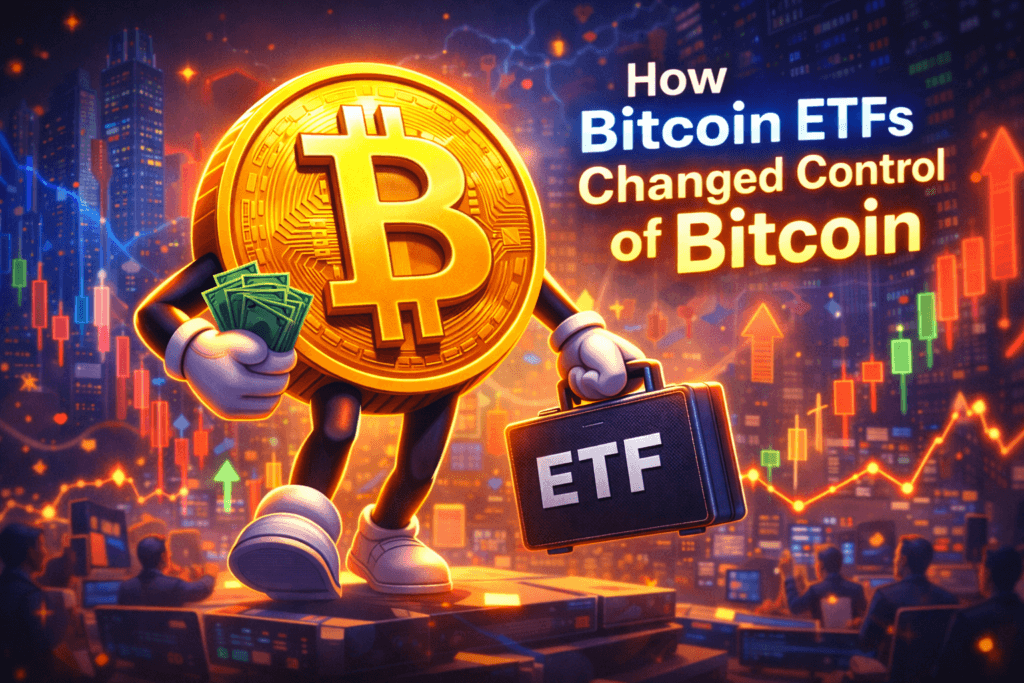
When Bitcoin started trading like a fund

Before ETFs, Bitcoin’s liquidity was fragmented across global exchanges. After ETFs, a growing share of price discovery now flows through a handful of U.S. custodians and market makers that service BlackRock, Fidelity, and other issuers.

On heavy inflow days, Bitcoin often rallies during U.S. market hours as authorized participants purchase BTC to create ETF shares. On outflow days, the opposite happens. That intraday rhythm has made Bitcoin behave less like a 24/7 asset and more like an equity index with a crypto heartbeat.

This has also increased short-term volatility. Large ETF redemptions compress selling into narrow windows, amplifying price swings even when long-term demand remains intact.

Bitcoin ETFs did not calm the market. They concentrated it.

The new power centers behind BTC

The custody and settlement layer of Bitcoin has quietly shifted.

Most ETF bitcoin is held by a small group of regulated custodians, including Coinbase and BNY Mellon. These firms now safeguard a massive percentage of circulating BTC on behalf of funds, effectively becoming the backbone of institutional bitcoin exposure.

That concentration creates new risks and new leverage. Decisions about fork support, network upgrades, or custody policy are now filtered through corporate compliance frameworks rather than grassroots consensus.

For the first time, Bitcoin’s infrastructure is being shaped by balance sheets instead of miners and nodes.

How capital flows are reshaping price behavior

ETF money does not think like crypto money.

Funds allocate based on macro signals, interest rates, equity correlations, and portfolio mandates. When inflation data surprises, or bond yields move, Bitcoin ETFs react. That means BTC is now trading as part of the global macro system.

In 2026, Bitcoin rallies are increasingly linked to shifts in real yields, dollar liquidity, and risk appetite across equity markets. When risk comes off, ETF redemptions turn into mechanical selling pressure.

This is why Bitcoin can drop sharply even without any crypto-specific news. The marginal buyer is no longer a retail trader. It is a fund manager rebalancing exposure.

The future of Bitcoin inside Wall Street

Bitcoin ETFs have given institutions a way to hold BTC without touching a wallet, but they have also created a new dependency: Bitcoin now needs Wall Street liquidity to sustain its rallies.

As more capital enters through ETFs, a larger share of Bitcoin’s fate is tied to regulatory decisions, fund flows, and macroeconomic shifts. That is the trade-off of legitimacy.

Bitcoin is still decentralized on-chain.
But in the markets that move its price, power has become highly centralized.

And that may be the biggest transformation of the Bitcoin era so far.

Sign Up For Daily Newsletter

Be keep up! Get the latest breaking news delivered straight to your inbox.
By signing up, you agree to our Terms of Use and acknowledge the data practices in our Privacy Policy. You may unsubscribe at any time.
Share This Article
Facebook Pinterest Whatsapp Whatsapp Telegram Threads Email Copy Link Print
How do you feel about this story?
Love0
Sad0
Happy0
Sleepy0
Angry0
Dead0
Wink0
ByBruno A
Follow:
Editor-in-Chief at MetroScroll. Passionate about uncovering the truth, exploring global issues, and delivering insightful, thought-provoking stories.
Previous Article Soft Forks and Hard Forks Are Quietly Rewriting Crypto Power
Next Article How NFTs Quietly Became a Pillar of Digital Asset Markets
Leave a Comment Leave a Comment

Leave a Reply Cancel reply

Your email address will not be published. Required fields are marked *

XFollow
PinterestPin
TelegramFollow
PayPalSend

You Might Also Like

CRYPTOCURRENCYINNOVATE

Fireblocks Acquires TRES Finance for $130M, Signals Crypto Paradigm Shift

Fireblocks is making waves in the crypto infrastructure space, announcing…

1 Min Read
DEFI & ON-CHAINLending & Borrowing

On-Chain Lending Volumes Rise Among Institutions

Large investors turn to blockchain-based credit as traditional funding costs…

3 Min Read
ALTCOINSMarket Trends

XRP and Sui Could Be 2026’s Breakout Cryptos as Adoption Builds

XRP and Sui are emerging as two potential comeback cryptocurrencies…

2 Min Read
DEFI & ON-CHAIN

DeFi Activity Stabilizes After Months of Volatility

On-chain volumes and capital flows suggest the sector is entering…

3 Min Read
MetroScrollMetroScroll
Follow US
© 2026 MetroScroll. All rights reserved.
Welcome Back!

Sign in to your account

Username or Email Address
Password

Lost your password?