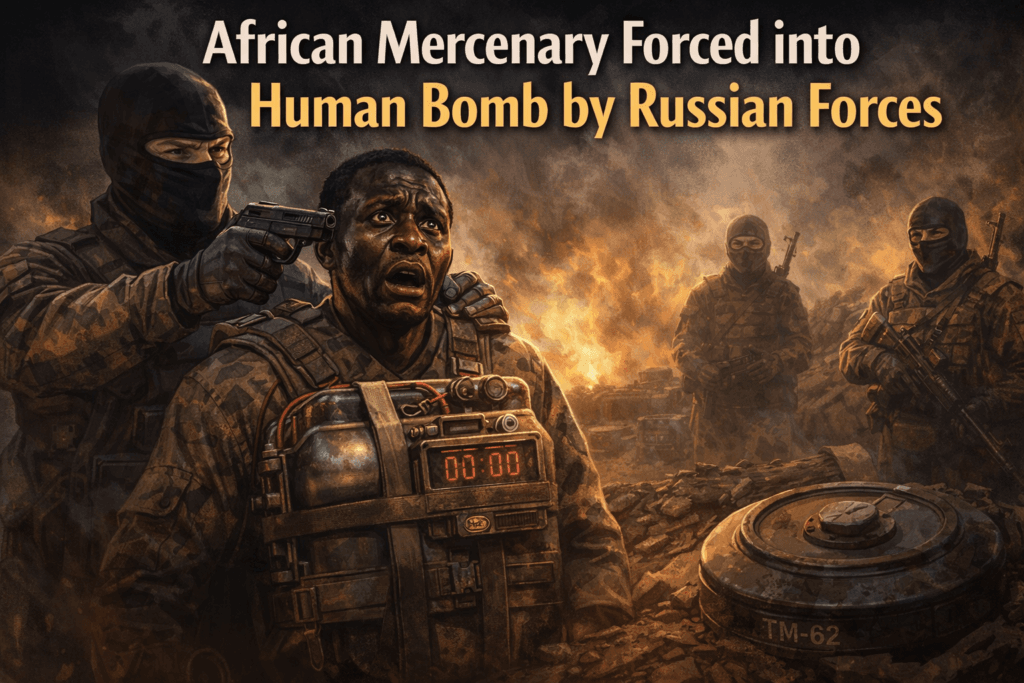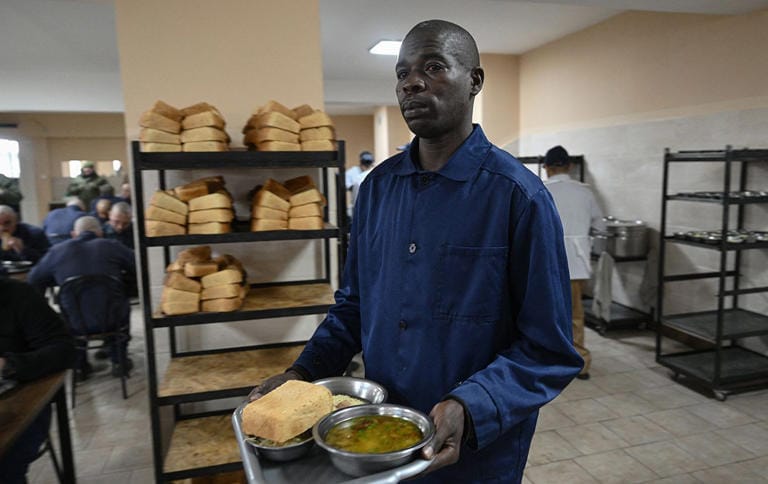

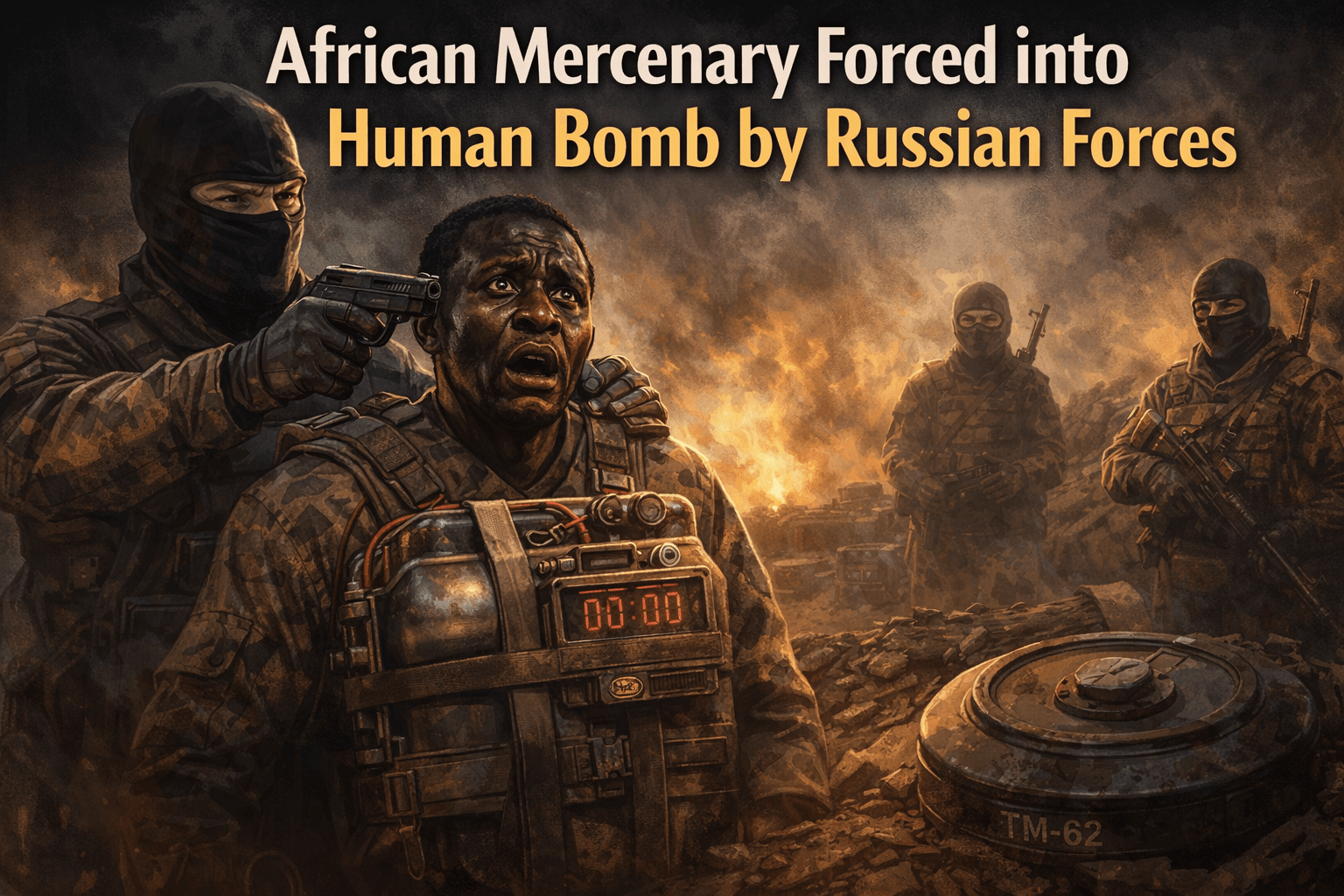

The video that began circulating across encrypted channels this week did not arrive with the polished framing of official war footage or the distance of satellite imagery. It arrived raw, unstable, and deeply uncomfortable, showing a terrified African recruit with a military explosive strapped to his chest as Russian soldiers shouted orders and slurs behind the camera. Whether every frame of the footage proves authentic or not, the reaction to it across intelligence, humanitarian, and financial circles was immediate. What mattered was not only the brutality being depicted but what it implied about the structure of the war now being fought.
Russia’s military campaign in Ukraine has quietly entered a phase that looks less like a conventional conflict and more like a capital-intensive industrial operation. The front lines are being fed by an expanding web of recruitment pipelines, weapons procurement routes, and financing mechanisms that no longer rely on state budgets alone. Moscow has been pulling in manpower from Africa, Asia, and the Middle East while relying on complex trade arrangements, sanctioned-proof shipping networks, and shadow payments to keep the machine running.
Western defense analysts have been tracking a surge in African mercenary contracts linked to Russian-connected entities since late 2024. These networks operate through mining concessions, oil transport, and private security firms, converting raw commodities into hard currency that bypasses the restrictions imposed by U.S. and European regulators. That money flows through clearing hubs in the Gulf, Turkey, and parts of Asia, often touching crypto rails and informal settlement systems before landing in procurement accounts used to buy drones, explosives, and battlefield logistics.
The video’s power comes from what it reveals about the end of that chain. Somewhere, a financial transaction funded the explosive strapped to the man’s chest. Somewhere else, another funded his transport to the front. By the time he appears on screen, the supply chain has already done its work. The human being has become the final delivery mechanism.
Inside Russia, the war has become increasingly insulated from public economic pain. Oil exports continue through non-Western buyers, discounted but steady. Grain, metals, and nuclear fuel still move across borders. The proceeds are no longer funneled through transparent sovereign accounts but through a patchwork of intermediaries that blur the line between state and private enterprise. This allows Moscow to sustain operations even as domestic budgets tighten and conventional borrowing remains restricted.
Ukraine, by contrast, remains dependent on visible Western support channels. Military aid packages, defense contracts, and budget transfers are debated in public legislatures and reflected in national accounts. Russia’s model, opaque and transactional, makes it harder to quantify how much capital is being deployed and from where. That imbalance is becoming one of the war’s defining asymmetries.
The use of foreign mercenaries is not simply about filling gaps in manpower. It is about cost control. These fighters are cheaper to recruit, easier to discard, and politically invisible inside Russia. The risks associated with their deaths do not translate into domestic unrest or parliamentary scrutiny. They exist in the same financial logic as expendable hardware.
What the footage has done is pierce the abstraction. Investors, diplomats, and policy analysts who track this conflict largely through commodity prices, sanctions reports, and capital flow data are being confronted with the human endpoint of those systems. The war is no longer just being waged with tanks and missiles. It is being sustained by supply chains that turn people into consumable assets.
Behind closed doors, Western officials are already discussing how to disrupt these channels. Sanctions are shifting away from headline targets toward logistics firms, shipping insurers, and financial intermediaries that move war-linked funds. The goal is not simply to punish Russia but to increase the cost of each additional day of fighting.
For Russia, the calculation is different. As long as the machinery keeps moving, the war can continue regardless of public opinion or battlefield losses. The mercenaries, the shadow payments, and the off-book trade routes form a system designed to absorb shock.
The video, horrifying as it is, has become a data point in a much larger equation. It shows how far the war economy has evolved from the early days of 2022. This is no longer a clash of armies alone. It is a globalized network of capital, commodities, and coercion, and the people on the ground are increasingly the least protected part of it.