


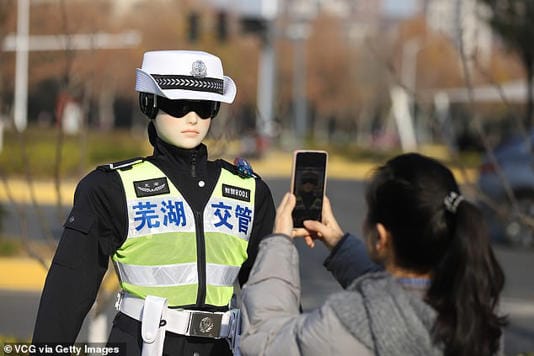
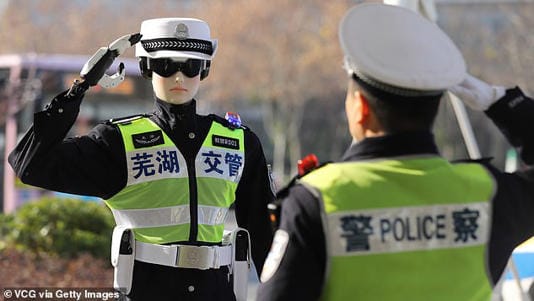
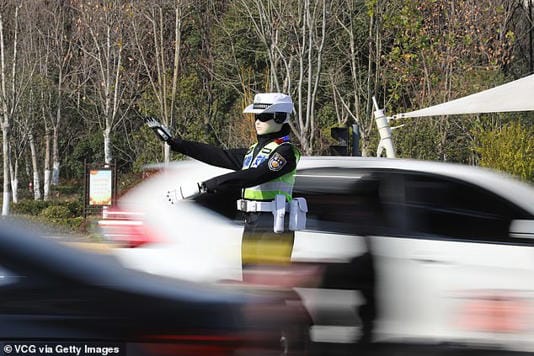
On January 20, 2026, the futuristic vision of automated policing became a reality in eastern China. Developed by AiMOGA Robotics, the “Intelligent Police Unit R001” (internally known as “Wuyou”) has moved from pilot testing to frontline operations. Stationed on safety islands, these robots use multi-modal perception to identify “irregular behavior”—such as cyclists veering into motor lanes or illegal parking—and immediately broadcast voice warnings to the public.
While pedestrians are currently treating them as “local celebrities” and pausing for selfies, the technology behind them is dead serious. These units are integrated into the city’s central traffic signal system, performing standardized hand gestures in perfect sync with the lights. For the Chinese government, this is more than a gimmick; it’s the spearhead of a projected 1 trillion yuan ($140 billion) “embodied intelligence” industry that aims to replace human officers in high-risk, repetitive environments by 2035.
The Narrative They’re Feeding You
The official line from traffic police officer Jiang Zihao is that these are “new colleagues” designed to ease the workload during extreme weather and peak hours. However, the Elephant in the Room is the massive expansion of the surveillance state. These robots don’t just “direct traffic”; they collect vast amounts of “real operational data” to train more advanced AI. By placing a humanoid face on a surveillance camera, the state is normalizing the presence of autonomous enforcers in the most intimate spaces of daily life.
The Anatomy of a Failure
Critics point out that while these robots are efficient at “barking orders,” they lack the human judgment required for complex emergencies. However, the manufacturer, AiMOGA, argues that “products that remain in the laboratory never truly mature.” By deploying these units in dense, noisy intersections, China is skipping the ethics debate and going straight to “rapid iteration.” This creates a feedback loop where the AI learns how to manipulate human behavior on the street, potentially leading to a system where non-compliance is met with immediate, automated consequences.
The Brutal Reality
The Brutal Reality is that the “robocop” is no longer a movie trope—it’s a labor solution. China’s shrinking workforce and the physical toll of traffic duty (exhaust, noise, and heat) make robots the logical financial choice for municipal budgets. With over 150 humanoid robot companies now operating in China and global deliveries reaching 30+ countries in 2025, the R001 unit is just the beginning. Today they are reminding you to stay in the bike lane; tomorrow, they could be the ones authorizing your access to public spaces based on your social credit.