
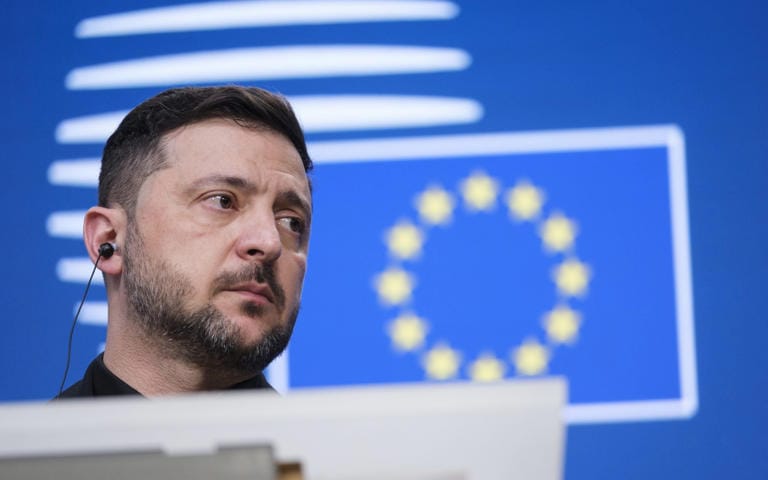

Europe’s pledge of support for Ukraine is at a crossroads. On one hand, a €90 billion Eurobond-based loan secured in Brussels on Thursday ensures Ukraine’s survival this winter. With this funding, Kyiv will be able to continue paying its soldiers and maintaining its resistance against Russian aggression. This is undoubtedly good news, as it guarantees Ukraine can keep fighting without collapsing financially.
However, Europe’s well-meaning rhetoric is not always followed by selfless action. European leaders may have agreed on the loan, but their reluctance to seize Russian assets frozen in Belgium to support the war effort shows a deeper divide. Although the Eurobond deal is a better option to avoid legal challenges from Moscow, it highlights Europe’s hesitance to take real responsibility. European governments, which should be investing more in Ukraine’s struggle, have instead turned to bond markets rather than dipping into their own budgets, raising concerns about their commitment to Ukraine’s cause.
Belgium’s Prime Minister Bart De Wever faced criticism for blocking European Commission plans to confiscate Russian Central Bank assets, arguing that Belgium should not bear the burden alone if Russian reparations are never paid. Some countries, like Spain, the Netherlands, and Belgium, still make significant deals with Russia, importing Russian liquefied natural gas. Austria’s Raiffeisen and Italy’s Unicredit banks continue operating in Russia, further revealing how European countries sometimes prioritize their own interests over Ukraine’s immediate needs.
Despite these setbacks, Ukrainian Foreign Minister Sergiy Kyslytsya acknowledged the progress, stating that the Eurobond loan is a workable solution. He tweeted, “Perfect is the enemy of good,” acknowledging that, while not ideal, the deal provides the financial support Ukraine desperately needs.
However, the growing question is: If Europe truly considers supporting Ukraine an existential issue for its own security, why is it so reluctant to directly invest in the war effort? Instead of putting up its own money, Europe has relied on Eurobond investors to fund Ukraine’s defense. European leaders, including Polish Prime Minister Donald Tusk, have framed the situation as a simple choice: “Either money today, or blood tomorrow.” Yet, Europe’s reluctance to fully fund the war through its own resources shows a disconnect between its words and actions.
As French President Emmanuel Macron recently noted, Europe must not let intermediaries—like Russia’s frozen assets—lead the conversation. It’s clear that if Ukraine is to secure a future free from Russian aggression, Europe must step up more decisively. For now, the Eurobonds represent a temporary solution, but the broader geopolitical implications remain unresolved.