

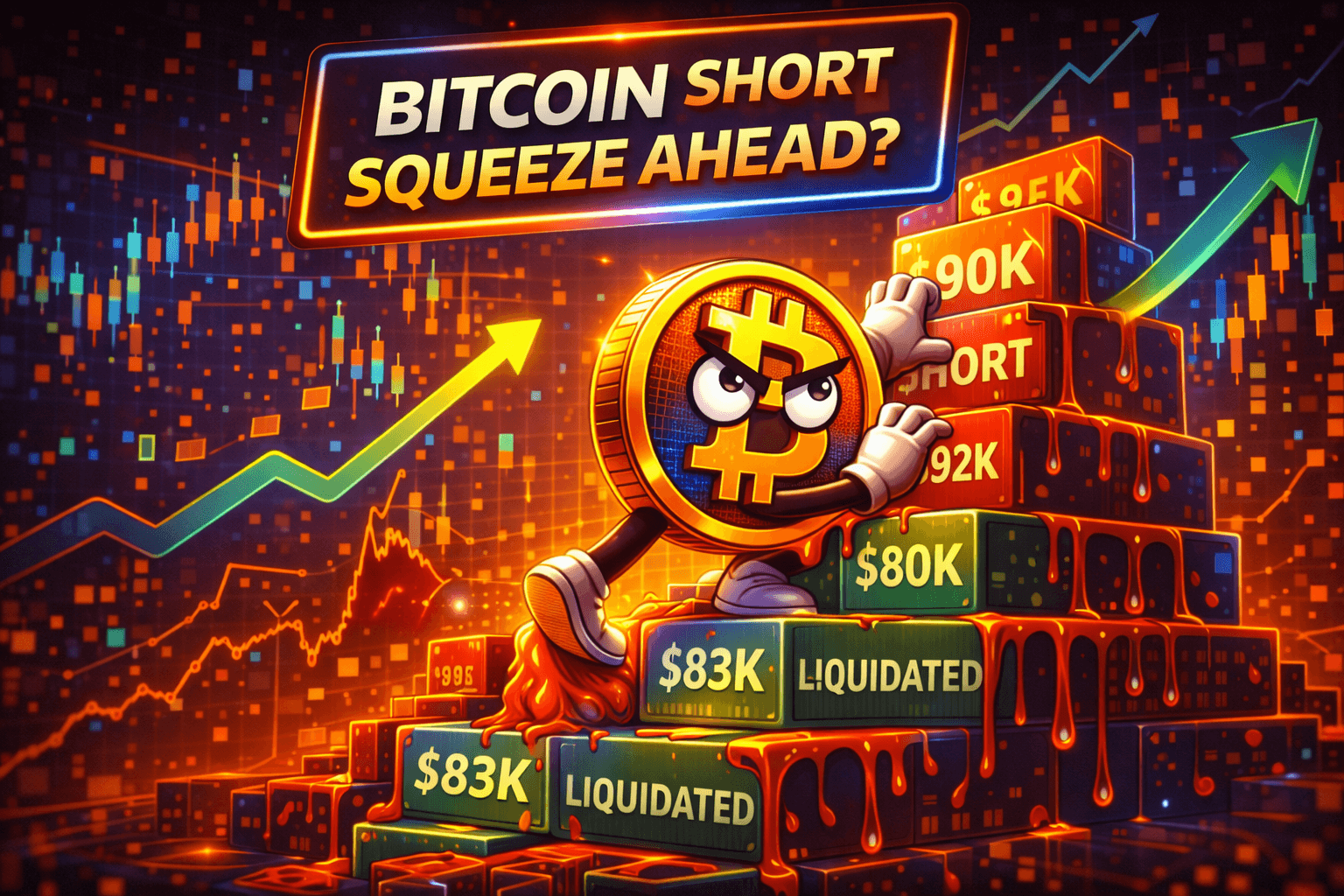

Bitcoin’s price slide has pushed derivatives markets into extreme imbalance, raising the odds of a sharp liquidation-driven rebound as traders reposition after weeks of downside pressure.
Bitcoin (BTC) has fallen 14.5% over the past 16 days, dragging the Crypto Fear & Greed Index down to 16 — its lowest level of the year. While spot prices remain under pressure, futures data suggest the recent sell-off may have cleared enough downside liquidity to set up a countertrend move.
After sweeping key swing lows between $80,000 and $83,000, Bitcoin flushed a large cluster of long liquidations. With that downside liquidity absorbed, market attention is shifting to the upside, where leverage is now heavily skewed.
Derivatives data from CoinGlass show that a move toward the $92,000 region would place more than $6.5 billion in cumulative short positions at risk of liquidation. By contrast, a drop toward $72,600 would only threaten around $1.2 billion. This imbalance increases the probability of forced short covering if price starts to move higher, potentially accelerating a relief rally.
Some analysts frame the recent price action as a classic Wyckoff “Spring,” where price briefly breaks below support to shake out weak hands before reversing. In this scenario, the dip below $83,000 may represent a final liquidity grab, allowing larger players to accumulate Bitcoin at discounted levels.
If buying pressure sustains, upside targets extend back toward the $90,000–$100,000 range, where prior supply and psychological resistance sit.
Futures Positioning Paints a Mixed Picture
Despite the sharp drawdown, traders are not fully exiting the market. Bitcoin’s decline triggered an estimated $800 billion in liquidations over the past 24 hours, marking one of the largest single-day wipeouts since late November, when BTC last traded near $81,000.
However, open interest on Binance has climbed to roughly 123,500 BTC, up more than 30% from early October levels. The increase suggests traders are rebuilding exposure rather than abandoning positions altogether.
At the same time, broader derivatives activity has cooled. Monthly Bitcoin futures volume across exchanges slipped to approximately $1.09 trillion in January, the lowest level since 2024. Trading remains concentrated on major venues, led by Binance, followed by OKX and Bybit.
The combination of reduced volume, rising open interest, and a heavily skewed liquidation map leaves Bitcoin at an inflection point. A push higher could trigger a cascade of short liquidations, while failure to reclaim momentum risks renewed downside probing.