



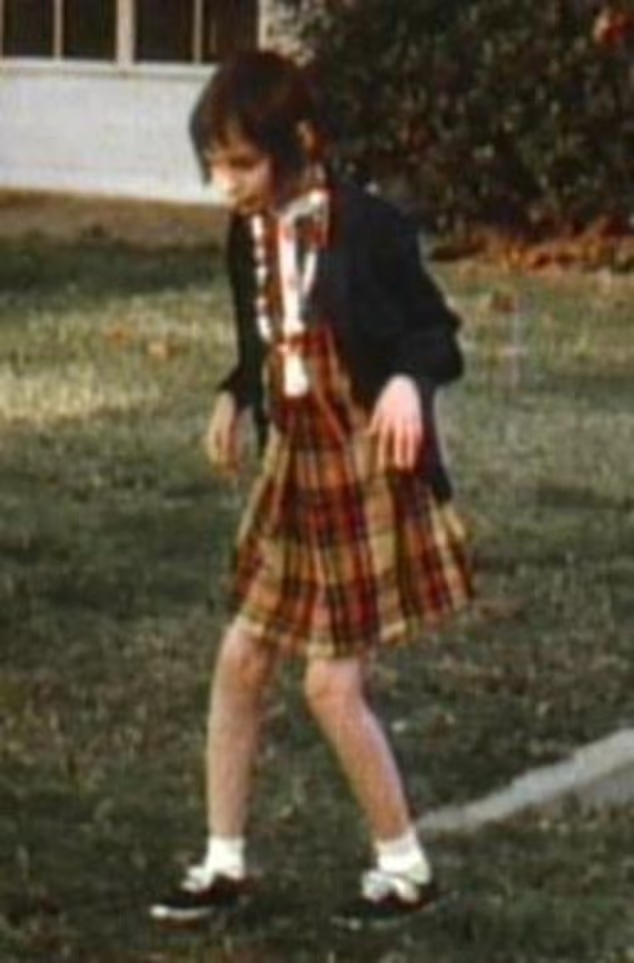
The story of Genie Wiley is widely marketed as a “miracle of rescue,” but let’s strip away the professional jargon. In November 1970, a thirteen-year-old girl emerged from a decade of literal hell in a Los Angeles suburb. But instead of finding sanctuary, she became the ultimate “shiny object” for a pack of ambitious scientists, linguists, and psychologists who saw her not as a broken child, but as a career-making specimen.
Genie had been strapped to a potty chair for over ten years, beaten by a father who barked at her like a dog, and malnourished to the point of skeletal deformity. Yet, the moment she was “saved,” the scientific community broke into a savage tug-of-war to see who could own her data. This wasn’t just research; it was a high-stakes grab for academic fame.

The “Critical Period” Scam: Using a Child as a Petri Dish
Linguists at UCLA and the Children’s Hospital didn’t just want to help Genie talk; they wanted to prove the Critical Period Hypothesis (CPH). This theory argues that if you don’t learn a language by puberty, you never will. For researchers like Dr. Susan Curtiss, Genie was a “once-in-a-lifetime opportunity” that was ethically impossible to replicate in a lab.
Let’s call it what it is: Genie was a biological experiment. They poked, prodded, and recorded her every grunt and “bunny-hand” gesture to win grants and write books. While they were busy debating her “syntax,” Genie was still a terrified girl who had been harnessed naked to a chair for 11 years. They treated her recovery like a race against a clock, desperate to see if they could “unlock” her brain before the funding ran out.
The Controversy Everyone is Ignoring: The NIMH Funding Pull-Out
The ultimate betrayal didn’t come from her father; it came from the National Institute of Mental Health (NIMH). In 1975, after five years of using Genie to gather “data,” the NIMH decided the research wasn’t “scientific enough” and pulled the plug on the money.
The moment the cash stopped flowing, the “experts” scattered. Dr. David Rigler—who had been fostering Genie while receiving government checks—suddenly realized he couldn’t keep her. Genie was tossed back to her nearly blind, mentally unstable mother, and then into a series of brutal foster homes where she was allegedly beaten for vomiting. The “scientists” got their books and their PhDs; Genie got sent to an institution to rot in silence.
The “Cold Hard Truth” from the Insiders
What are the insiders saying now? The “tug-of-war” between Jeanne Butler (the therapist who actually loved her) and the UCLA researchers was a bloodbath. Butler accused the team of exploiting Genie for fame; the team accused Butler of being an “unprofessional” obstacle to science.
The “Expert Roast” is simple: They prioritized the “Wild Child” narrative over the human being. They renamed her “Genie” to make her sound like a mythical creature instead of a victim of felony child abuse. Today, if she is still alive at 68, she is likely a ward of the state, living in an invisible cage of silence because the people paid to “save” her stopped caring the second the grant money dried up.
Deep Background: The Wiley House of Horrors
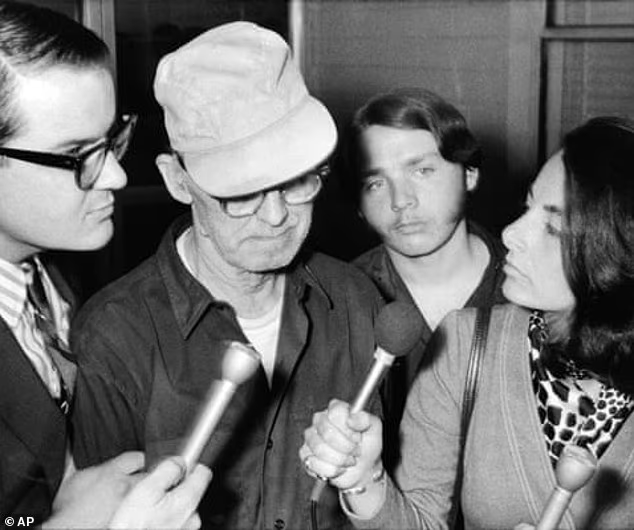
Clark Wiley, the patriarch, was a monster who slept by the front door with a shotgun on his lap to keep the world out. He forced the family into total silence. No radio, no TV, no voices. When Genie made a sound, he hit her. He committed suicide the day he was due in court, leaving a note that read: “The world will never understand.” No, Clark, we understand perfectly. You were a coward, and the system that “rescued” your daughter was just a more polite version of your cage.
The “What’s Next” Section: The Legacy of Failure
Genie Wiley’s case is taught in every psychology 101 class in America. But the lesson isn’t about language; it’s about ethical bankruptcy. As of December 20, 2025, Genie’s exact location remains a state secret. She is a ghost in the system—a reminder that sometimes, the “help” is just as predatory as the harm.