

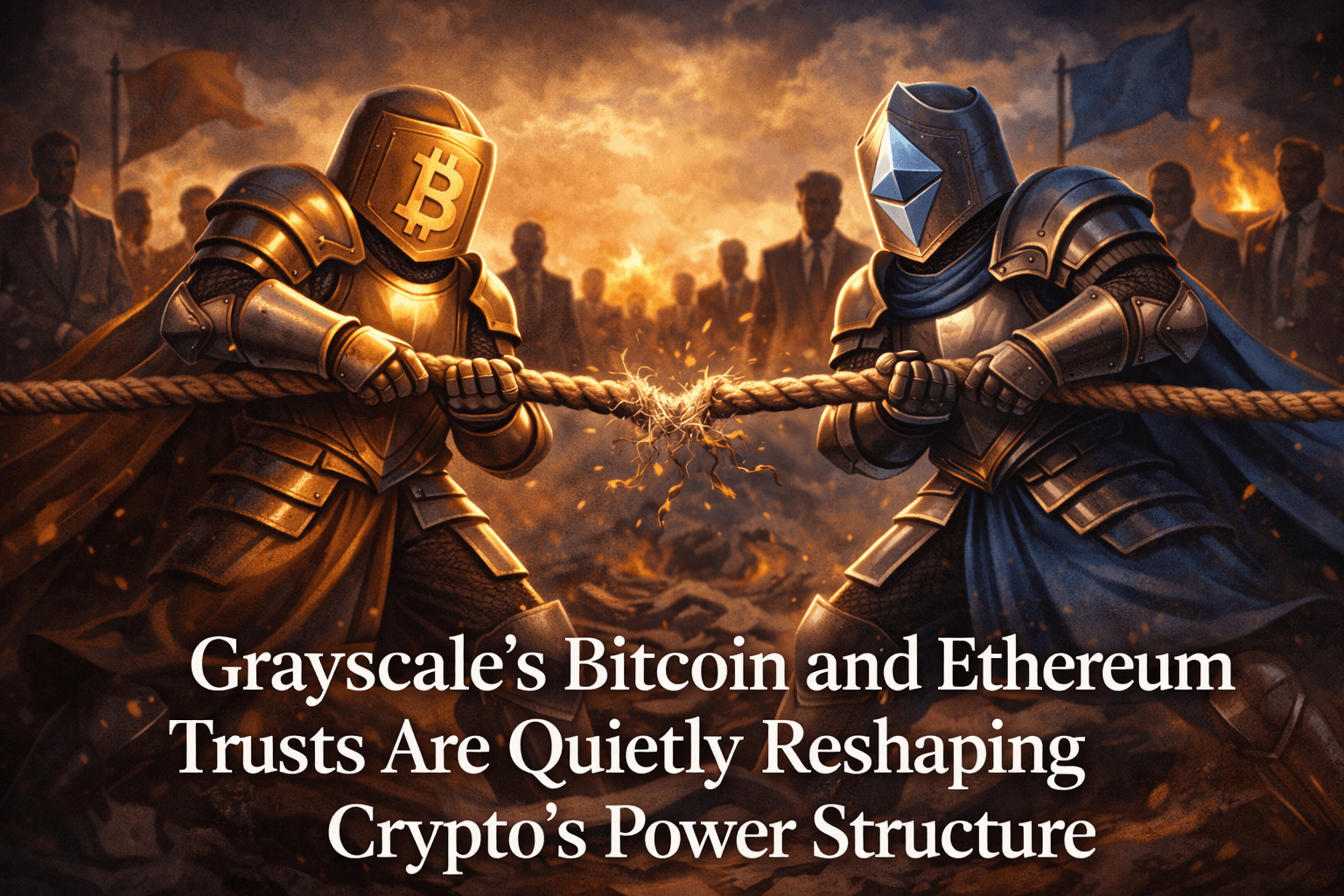

Behind the familiar GBTC and ETHE tickers, a fee war, widening discounts, and shifting investor flows are redrawing how institutions gain exposure to digital assets.
For years, Grayscale’s Bitcoin Trust and Ethereum Trust have been the primary gateways between Wall Street and crypto. They offered a regulated bridge into Bitcoin and Ether long before ETFs existed, drawing billions from hedge funds, family offices, and retirement accounts.
But in 2026, that bridge is under strain.
With spot crypto ETFs draining liquidity, trust fees still hovering near record highs, and persistent discounts to net asset value, the two flagship Grayscale products are now competing not just with each other—but with an entirely new market structure.
Bitcoin and Ethereum may be rising on the charts, but inside Grayscale’s trusts, capital is moving very differently.
The fee drag no one can ignore
Grayscale Bitcoin Trust charges an annual management fee of 2%. Grayscale Ethereum Trust charges even more at 2.5%. In an era where Bitcoin and Ethereum ETFs are now available with fees measured in basis points, that difference has become impossible for professional investors to justify.
Every year, GBTC and ETHE holders see their underlying crypto reduced as Grayscale takes its cut in Bitcoin or Ether. For long-term investors, that silent erosion compounds into a material drag on performance, especially during sideways markets.
That has triggered an exodus. Since spot ETFs launched, GBTC alone has shed tens of billions of dollars in assets as investors rotate into cheaper, more flexible structures. Ethereum’s trust is facing the same reckoning.
The trusts still hold massive pools of crypto, but the money inside them is no longer as loyal as it once was.
Discounts that won’t close
Unlike ETFs, Grayscale’s trusts do not redeem shares for their underlying assets. That structural flaw has turned what should be simple tracking vehicles into complex market instruments.
Shares of both GBTC and ETHE regularly trade at discounts to the value of the Bitcoin and Ethereum they hold. In extreme cases, those discounts have stretched into double digits, allowing investors to buy crypto exposure for less than its market price—but trapping capital for those who need liquidity.
Those discounts have become a key battleground between Bitcoin and Ethereum investors. When Ethereum rallies, ETHE’s discount often narrows faster than GBTC’s, reflecting different expectations about institutional demand. When risk fades, both trusts see their discounts widen as traders rush for the exits.
In 2026, these gaps are no longer anomalies. They are a permanent feature of how Grayscale’s products trade.
How institutions are choosing sides
Bitcoin remains the dominant asset inside institutional crypto portfolios, but Ethereum is quietly gaining ground through Grayscale’s structure.
Funds that want exposure to decentralized finance, tokenization, and stablecoin settlement are increasingly leaning toward Ether rather than Bitcoin. That shift has pushed more speculative capital into ETHE, even as its higher fee creates more friction.
At the same time, conservative allocators continue to favor GBTC for its liquidity and historical role as the original institutional Bitcoin vehicle, despite its fee burden.
The result is a split market: Bitcoin Trust as a legacy store-of-value channel, Ethereum Trust as a growth and infrastructure bet.
That divide is shaping how capital flows across crypto’s largest networks.
Why the trust model is breaking
Grayscale built its empire on a model that made sense when ETFs were banned and custody was complex. That era is over.
Now, investors can access Bitcoin and Ethereum through fully regulated ETFs with intraday liquidity, creation and redemption mechanisms, and lower costs. Against that backdrop, closed-end trusts look increasingly outdated.
Yet Grayscale still controls enormous pools of crypto, and those holdings matter. When money exits GBTC or ETHE, Grayscale must sell Bitcoin or Ether into the market, turning investor redemptions into real supply.
That makes these trusts not just passive vehicles, but active forces in crypto’s liquidity cycle.
As 2026 unfolds, the competition between Grayscale Bitcoin Trust and Grayscale Ethereum Trust is no longer about which asset will outperform.
It is about which structure can survive.