

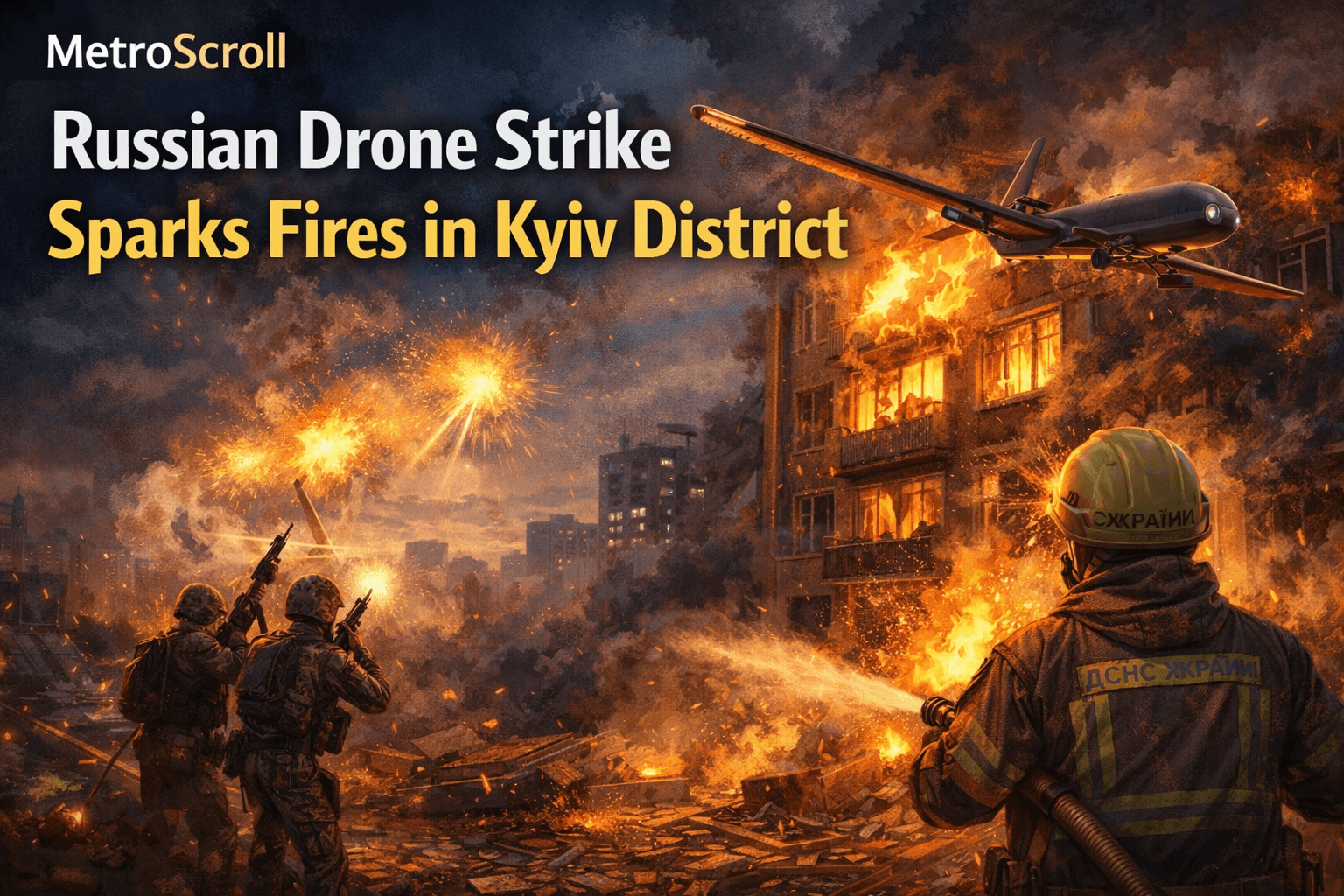

A Russian drone tore into Kyiv’s Solomyansky district just after midnight, igniting fires in non-residential structures and scattering debris close to residential blocks, in another reminder that Ukraine’s capital remains squarely in the crosshairs of Moscow’s long-range campaign. Emergency crews were deployed within minutes as air-defence systems lit up the night sky, intercepting multiple incoming targets while fragments rained down across the neighbourhood.
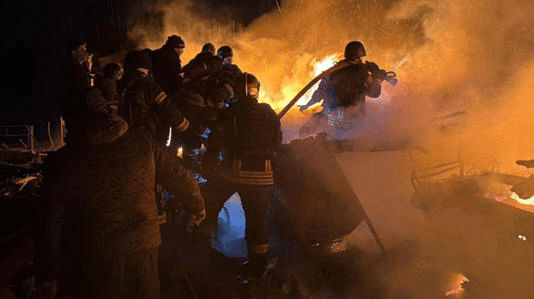
Kyiv Mayor Vitalii Klitschko confirmed that at least two separate fires broke out following the impact, one from a direct strike on a non-residential building and another from falling weapons debris. Windows in nearby homes were blown out by the blast, underscoring how thin the line has become between military targets and civilian life as Russia leans harder on drone warfare to apply pressure far from the front lines.
The attack comes as Russia continues to expand its use of low-cost, long-range drones to stretch Ukraine’s air-defence resources. These strikes are no longer isolated incidents but part of a sustained campaign aimed at degrading infrastructure, exhausting emergency response systems, and forcing Kyiv to divert military assets away from the battlefield. Each drone may carry a relatively small payload, but their cumulative effect is reshaping how the war is fought above Ukraine’s cities.
Behind the scenes, Ukraine’s partners are racing to accelerate deliveries of air-defence systems and ammunition as stocks are burned through at a relentless pace. Western defence firms have seen order books swell as demand for interceptors, radar systems, and counter-drone technology surges, turning the skies over Kyiv into a proving ground for the next generation of urban air warfare.
For residents of the capital, the strategic calculations play out in the most immediate way possible. Nights are punctuated by sirens, explosions, and the crack of air-defence fire, while emergency workers move from one impact site to the next. Even when fires are contained and buildings spared from collapse, the psychological toll of never knowing where the next drone will fall continues to mount.
Russia’s reliance on drones also signals a shift in its broader military strategy. With conventional missile stocks under pressure and front-line advances costly, Moscow has found in unmanned systems a way to keep pressure on Ukraine’s political and economic heart without committing large numbers of troops. Kyiv, in turn, is being forced into a costly defensive posture, investing heavily in protection rather than reconstruction.
The latest strike in Solomyansky district may not have hit a critical facility, but it fits into a larger pattern that is slowly rewriting the rules of urban warfare. As drones become cheaper and more numerous, no city within range is truly out of reach, and Kyiv’s skyline has become the front line of a conflict that shows no sign of easing.