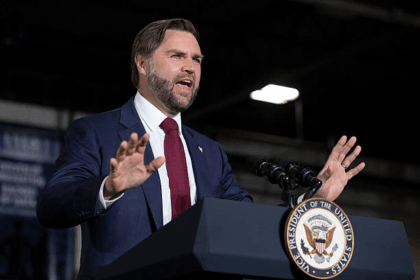


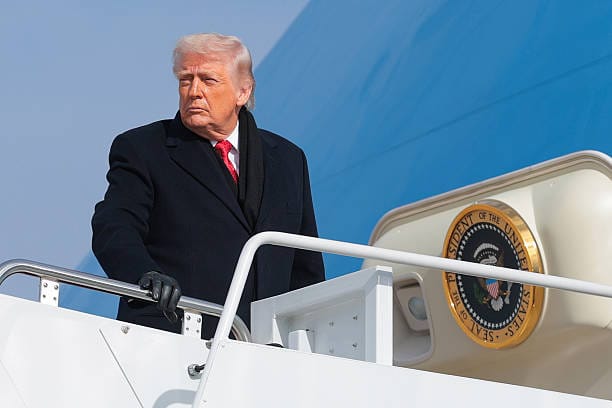
Donald Trump’s flight to the World Economic Forum in Davos was disrupted Tuesday night after Air Force One experienced a minor electrical issue, forcing the aircraft to turn back shortly after takeoff.
According to a White House pool report, the aircraft was rerouted to Joint Base Andrews in Maryland as a precaution. Flight tracking data showed the plane turning around over waters near Long Island, New York, before returning toward Washington, D.C.
White House Press Secretary Karoline Leavitt said the crew identified the issue shortly after departure and decided to land out of an abundance of caution. Trump will continue his trip to Davos, Switzerland, aboard a backup aircraft, the pool report confirmed.
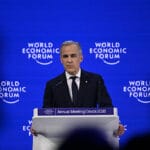
The delay is expected to push back Trump’s arrival in Zurich, where he is scheduled to attend meetings with global business and political leaders at the World Economic Forum. The forum has already been marked by heightened attention surrounding Trump’s remarks on trade, energy policy, and Greenland.
The aircraft currently serving as Air Force One is a Boeing VC-25, a heavily modified military version of the Boeing 747. The fleet is scheduled to be replaced by two new 747-8 aircraft by 2028, at an estimated cost exceeding $5 billion.
Amid repeated delays in the replacement program, Trump has publicly discussed using an alternative 747-8 aircraft gifted by the Qatari government, valued at roughly $400 million. The aircraft was accepted by the U.S. Defense Department in May 2025. Leavitt reportedly joked with reporters that the Qatari jet “sounded much better” following the technical issue.
During the flight, reporters noted that lights in the press cabin briefly went out, though officials said the cause was unclear.
Trump’s Davos appearance comes amid controversy over his renewed statements regarding Greenland, a semi-autonomous territory governed by Denmark. He has reiterated interest in acquiring the territory and confirmed that Greenland-related discussions are scheduled during the forum.
Trump has also warned of additional 10% tariffs on Denmark and several European countries—including Germany, France, the UK, Sweden, Norway, Finland, and the Netherlands—if negotiations over Greenland do not progress.