
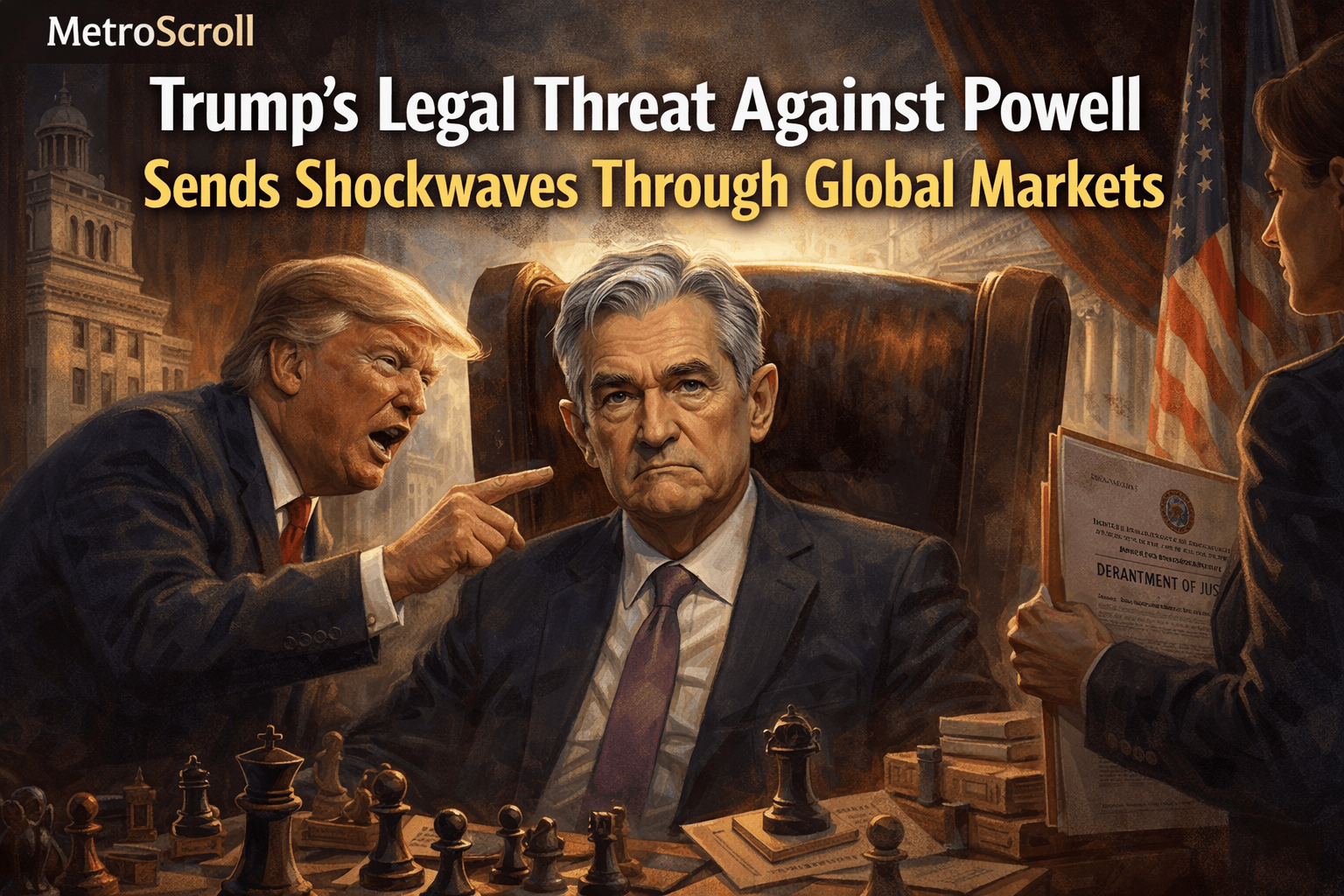

The confrontation between the White House and the Federal Reserve has moved into territory global markets rarely have to price in: legal pressure on a sitting central bank chair. Jerome Powell’s disclosure that the Justice Department issued grand jury subpoenas over his testimony about a $2.5 billion renovation project did more than rattle Washington. It forced investors to confront the possibility that U.S. monetary policy could become another lever in a widening political struggle over inflation, growth, and the cost of money.
The market reaction was immediate. Long-dated U.S. Treasury yields climbed as traders demanded a higher inflation risk premium. The dollar weakened. Gold surged to record highs. Bank stocks slipped as the prospect of political interference in rate-setting injected instability into credit markets. These moves were not emotional—they were structural. Capital was repricing the credibility of the world’s most powerful central bank.
For more than a generation, Federal Reserve independence has been the hidden backbone of global finance. It is what allows foreign governments to hold trillions in Treasuries, multinational corporations to borrow in dollars, and institutional funds to price risk with confidence. When Powell publicly described the indictment threat as a “pretext” for exerting control over interest rates, that confidence fractured.
Behind closed doors, the largest pools of capital have already been repositioning. Pension funds, sovereign wealth funds, and macro hedge funds have increased exposure to inflation-protected bonds, commodities, and alternative stores of value. Crypto desks report a noticeable rise in demand for volatility protection tied not to token news, but to macro instability. When monetary policy becomes political, no asset class is insulated.
Trump’s push for lower rates is not new. What is new is the method. Using the Justice Department as leverage over the central bank introduces a tool that has never been priced into U.S. markets. Powell’s chairmanship ends in May, but his seat on the Federal Reserve Board runs until 2028. That timeline determines whether this confrontation ends with a replacement—or with a standoff that could reshape monetary authority for years.
Bond markets are already signaling what equity traders are not. Rising long-term yields suggest investors believe inflation control may weaken, not strengthen, if political pressure succeeds. The price of money is starting to drift upward, not because the economy is overheating, but because trust in the referee is eroding.
Crypto sits in the middle of this power shift. Bitcoin and Ethereum are now institutional assets, held through ETFs, custody banks, and regulated brokerages. They benefit from distrust in fiat systems, but they are also exposed to regulatory backlash when capital tries to escape. As the Fed’s authority is questioned, demand for decentralized stores of value grows—while the pressure to contain them intensifies.
This is the real story most traders are missing. It is not about a building renovation or a subpoena. It is about who controls the world’s most important interest rate. And markets are already moving as if the answer may no longer be the Federal Reserve.