

By using this site, you agree to the Privacy Policy and Terms of Use.
Accept
MetroScroll
  • Home
  • Bitcoin
    • Price & Markets
    • Adoption
    • ETFs & Funds
    • Mining
    • Treasury & Corporates
  • Ethereum
    • Price & Markets
    • Staking
    • Layer-2 & Scaling
    • Development
    • Ethereum vs Bitcoin
  • FINANCE
    • Market News
    • Regulation & Policy
    • Security & Cybercrime
    • Institutional
      • Banks & Asset Managers
      • Crypto Index Products
      • Corporate Treasuries
      • Custody & Infrastructure
      • ETFs & Funds
    • Stablecoins
      • USDT
      • USDC & Others
      • Payments & Remittances
      • Regulation
    • Altcoins
      • Market Trends
      • Solana
      • XRP
      • Layer-1 Blockchains
      • Meme Coins
      • AI Tokens
    • Web3 & nft
      • NFTs
      • Gaming & Metaverse
      • Infrastructure
      • Digital Identity
      • Social & Creator Economy
    • Defi & On-Chain
      • DeFi Markets
      • Lending & Borrowing
      • Decentralized Exchanges
      • Tokenized Assets (RWA)
      • Institutional DeFi
  • LEARN
    • Crypto Basics
    • Risk Management
    • Wallets & Security
    • On-Chain Data
  • Technical Analysis
    • Bitcoin Analysis
    • Ethereum Analysis
    • Altcoin Analysis
    • Market Structure
    • Indicators & Levels
  • GLOBAL NEWS
    • CHINA
    • US
    • REGIONS
      • AFRICA
      • ASIA
      • EUROPE
    • CRIME & JUSTICE
    • LIFESTYLE
    • TECHNOLOGY
Reading: What Is Crypto?
SUBSCRIBE
MetroScrollMetroScroll
Font ResizerAa
  • Home
  • Bitcoin
  • Ethereum
  • FINANCE
  • LEARN
  • Technical Analysis
  • GLOBAL NEWS
Search
  • Home
  • Bitcoin
    • Price & Markets
    • Adoption
    • ETFs & Funds
    • Mining
    • Treasury & Corporates
  • Ethereum
    • Price & Markets
    • Staking
    • Layer-2 & Scaling
    • Development
    • Ethereum vs Bitcoin
  • FINANCE
    • Market News
    • Regulation & Policy
    • Security & Cybercrime
    • Institutional
    • Stablecoins
    • Altcoins
    • Web3 & nft
    • Defi & On-Chain
  • LEARN
    • Crypto Basics
    • Risk Management
    • Wallets & Security
    • On-Chain Data
  • Technical Analysis
    • Bitcoin Analysis
    • Ethereum Analysis
    • Altcoin Analysis
    • Market Structure
    • Indicators & Levels
  • GLOBAL NEWS
    • CHINA
    • US
    • REGIONS
    • CRIME & JUSTICE
    • LIFESTYLE
    • TECHNOLOGY
Follow US
  • Terms of Service
  • About Us
  • Privacy Policy
  • Contact Us
© 2026 MetroScroll. All rights reserved.
Home » Blog » What Is Crypto?
LEARN

What Is Crypto?

A clear look at how digital money works without banks or governments.

Bruno A
Last updated: January 11, 2026 6:08 pm
Bruno A
Published: January 11, 2026
Share
SHARE
Highlights
  • Cryptocurrency is digital money secured by cryptography and run by decentralized network

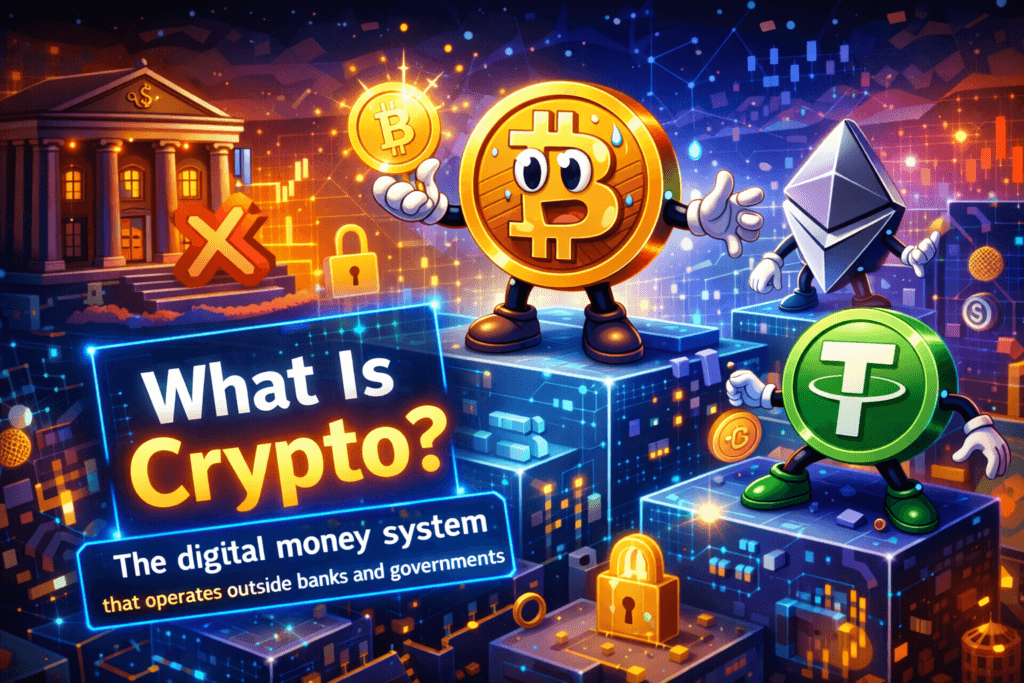
The digital money system that operates outside banks and governments

Cryptocurrency is a form of digital money built to move across the internet without relying on banks, payment companies, or governments to process transactions.

Contents
  • The digital money system that operates outside banks and governments
    • Why Crypto Doesn’t Need a Central Bank
    • How Digital Tokens Are Created and Secured
    • Why Crypto Became a Financial Movement

Instead of being issued by a central authority, crypto tokens are created and managed by software running on decentralized computer networks. These networks use cryptography to verify transactions, prevent fraud, and control how new coins are released into circulation.

Every payment made in crypto is recorded on a blockchain, a shared digital ledger that anyone can view but no single party controls. This ledger replaces the role of traditional financial institutions by confirming ownership and tracking transfers in real time.

Unlike traditional currencies, cryptocurrencies are not backed by central banks or national treasuries. Their value comes from supply rules written into code, network security, and market demand from users who treat them as money, assets, or financial infrastructure.
Why Crypto Doesn’t Need a Central Bank

In the traditional financial system, central banks issue money, commercial banks process payments, and clearinghouses settle transactions behind the scenes. Crypto replaces all of that with automated networks that follow fixed mathematical rules.

When someone sends crypto, the transaction is broadcast to a global network of computers that independently verify it. Once confirmed, it becomes a permanent part of the blockchain. No bank can reverse it, freeze it, or block it.

This structure allows crypto to operate across borders without permission, creating a global digital payment system that runs continuously without human gatekeepers.

How Digital Tokens Are Created and Secured

Cryptocurrencies are generated through predefined processes built into each network. Some use mining, where computers compete to secure the blockchain and earn new coins. Others use staking, where users lock up tokens to help validate transactions.

Security is provided by cryptography, which makes it nearly impossible to counterfeit coins or alter transaction records. Ownership is proven through private keys, giving users direct control over their funds instead of relying on a bank account.

Why Crypto Became a Financial Movement

Crypto gained momentum because it offers something traditional finance does not: money that exists independently of governments, banks, and corporate platforms.

For supporters, this means financial freedom, global access, and protection from inflationary policies. For critics, it represents volatility, regulatory risk, and challenges to monetary control.

That tension is exactly why crypto now sits at the center of debates about regulation, financial stability, and the future of money itself.


Sign Up For Daily Newsletter

Be keep up! Get the latest breaking news delivered straight to your inbox.
By signing up, you agree to our Terms of Use and acknowledge the data practices in our Privacy Policy. You may unsubscribe at any time.
Share This Article
Facebook Pinterest Whatsapp Whatsapp Telegram Threads Email Copy Link Print
How do you feel about this story?
Love0
Sad0
Happy0
Sleepy0
Angry0
Dead0
Wink0
ByBruno A
Follow:
Editor-in-Chief at MetroScroll. Passionate about uncovering the truth, exploring global issues, and delivering insightful, thought-provoking stories.
Previous Article Bitcoin’s $90,000 Standoff Is Testing Wall Street’s Conviction
Next Article What Is an NFT?
Leave a Comment Leave a Comment

Leave a Reply Cancel reply

Your email address will not be published. Required fields are marked *

XFollow
PinterestPin
TelegramFollow
PayPalSend

You Might Also Like

ALTCOINSBITCOINETHEREUMLEARNNEWS

Wall Street Giants Divided on Bitcoin’s 2026 Trajectory

The traditional four-year Bitcoin halving cycle—a roadmap that has guided…

2 Min Read
LEARN

What Is Crypto Options Trading?

The derivatives market that lets traders bet on crypto without…

3 Min Read
INSTITUTIONALLEARN

Grayscale’s Bitcoin and Ethereum Trusts Are Quietly Reshaping Crypto’s Power Structure

Behind the familiar GBTC and ETHE tickers, a fee war,…

5 Min Read
LEARN

The 5 Most Common Crypto Scams of 2026 (and How to Spot Them)

As we enter 2026, the sophistication of crypto fraud has…

4 Min Read
MetroScrollMetroScroll
Follow US
© 2026 MetroScroll. All rights reserved.
Welcome Back!

Sign in to your account

Username or Email Address
Password

Lost your password?