









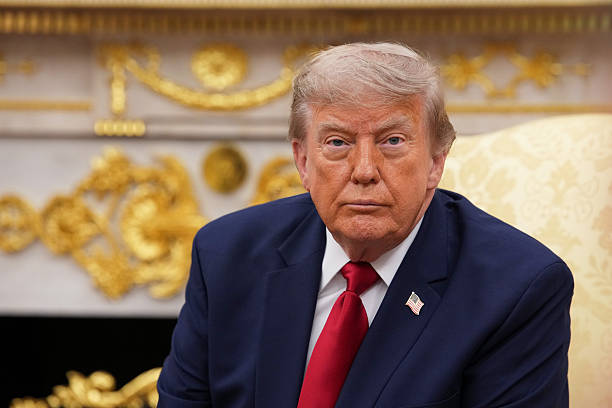

President Donald Trump has sent a landmark nuclear agreement with Saudi Arabia to Congress for review, opening the door to months of debate over the future of the kingdom’s nuclear program and the potential spread of sensitive nuclear technology in the Middle East.
The agreement was transmitted to lawmakers on Monday, according to an administration official. However, Trump has maintained a separate political condition for the deal to move forward: Saudi Arabia must normalize relations with Israel by joining the Abraham Accords.
The requirement was announced after the nuclear agreement had already been negotiated and signed, creating another obstacle to its implementation.
The 30-year agreement is expected to give U.S. companies a central role in developing Saudi Arabia’s nuclear infrastructure while excluding foreign competitors from the project.
The deal has nevertheless drawn controversy because it could potentially allow uranium enrichment to take place on Saudi territory.
Under U.S. law, the nuclear agreement must be submitted to Congress for review. While lawmakers can attempt to block it, doing so would require a joint resolution of Congress and a two-thirds majority vote to override a potential presidential veto.
The Saudi Embassy in the United States did not immediately respond to a request for comment.
Saudi officials have argued that the country needs a civilian nuclear industry to support its domestic energy needs.
The kingdom has uranium ore deposits that Saudi officials say they want to develop. They argue that using nuclear energy domestically could allow more of the country’s oil production to be exported, potentially increasing revenues.
Under the proposed arrangement, American and Saudi officials would conduct a two-year study examining whether it would be commercially viable for U.S. companies to construct a uranium enrichment facility in Saudi Arabia.
If the study concludes that domestic enrichment is necessary, American companies would build the facility under an arrangement designed to prevent the transfer of sensitive technology to Saudi Arabia.
Trump administration officials have argued that American involvement would help ensure that Saudi Arabia’s nuclear program remains peaceful.
Critics, however, say allowing uranium enrichment in the kingdom could weaken decades of U.S. efforts to limit the spread of sensitive nuclear fuel-making technology.
Andrea Stricker of the Foundation for the Defense of Democracies argued that Congress should reject any agreement that opens the door to uranium enrichment on Saudi territory, even if the facility is operated by the United States.
The dispute over nuclear technology is not the only challenge facing the agreement.
Trump has also insisted that Saudi Arabia normalize relations with Israel by joining the Abraham Accords before the nuclear agreement can move forward.
An administration official confirmed that Trump’s position remains unchanged.
“The President’s position has not changed that the agreement will only move forward if Saudi Arabia joins the Abraham Accords,” the official said.
The Abraham Accords were brokered by the United States in 2020 and signed by the U.S., Israel, the United Arab Emirates and Bahrain.
Saudi Arabia had appeared to be moving closer to normalizing relations with Israel during the Biden administration.
Those discussions were part of a broader potential agreement that would have included a U.S. defense pact and cooperation on a civilian nuclear program.
However, Saudi Arabia stepped back from the normalization process following Hamas’s October 2023 attack on Israel and Israel’s subsequent military campaign in Gaza.
The nuclear agreement now faces scrutiny on multiple fronts, with lawmakers weighing the potential benefits to the American nuclear industry against concerns about nuclear proliferation.
At the same time, Trump’s demand for Saudi participation in the Abraham Accords adds a major political condition that Riyadh must satisfy before the agreement can proceed.